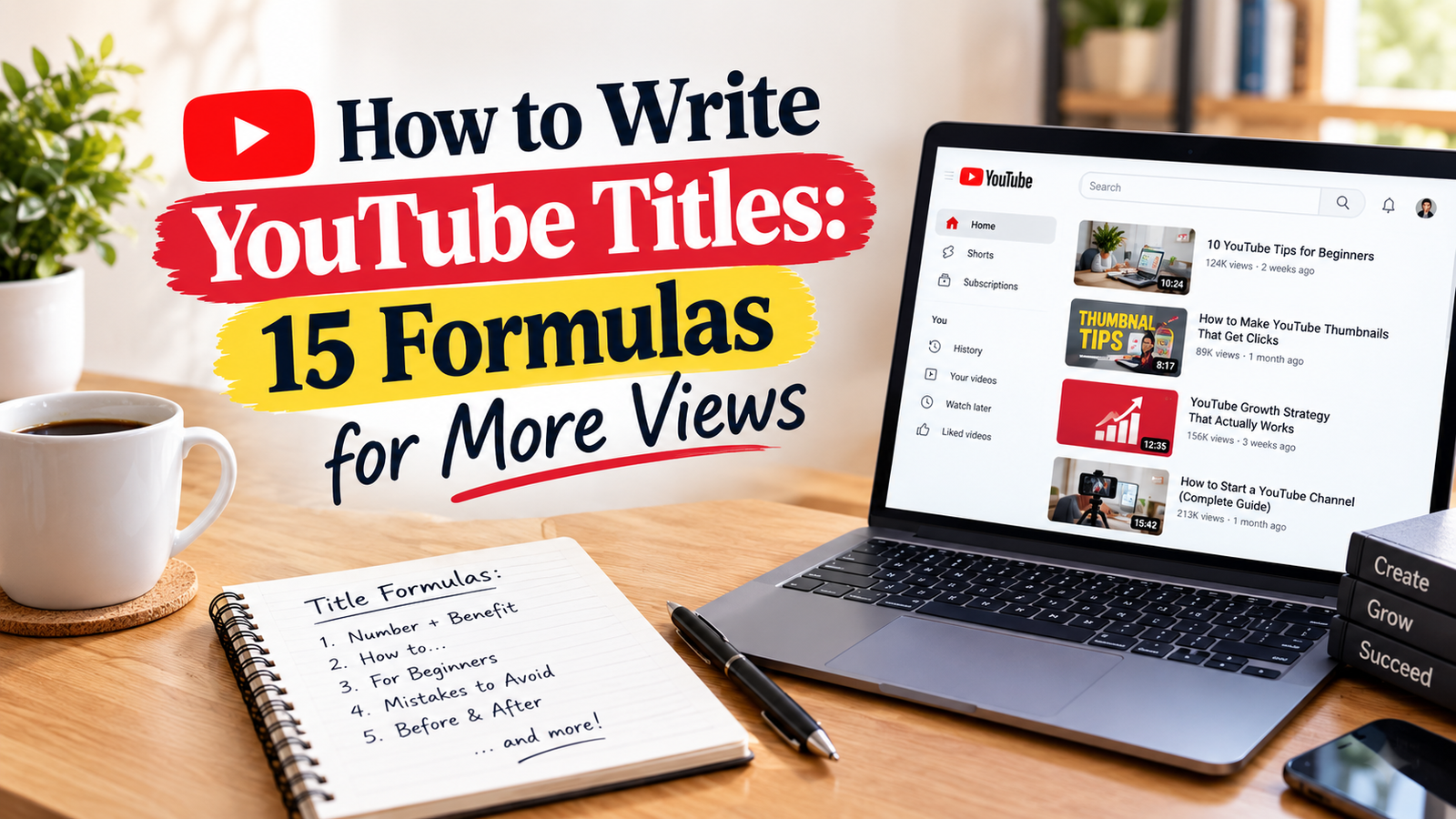
How to Write YouTube Titles: 15 Formulas for More Views
Getting people to click your YouTube video starts before they watch a single second. Your YouTube title is one of the first things viewers see, and a clear, interesting title can make the difference between someone scrolling past and someone choosing your video.
But writing good YouTube titles isn’t about stuffing keywords into a sentence or making exaggerated clickbait.
The goal is to create a title that quickly tells viewers what they will get, why it matters, and why they should care.
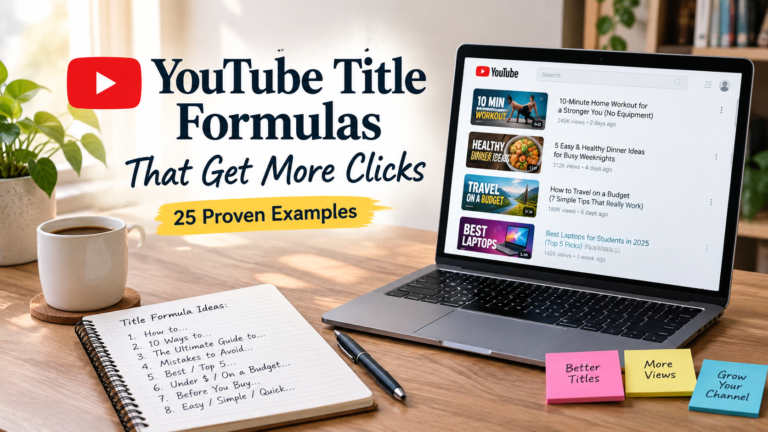
In this guide, you’ll learn how to write better YouTube titles and 15 practical title formulas you can adapt to different types of videos.
What Makes a Good YouTube Title?
A good YouTube title should be easy to understand, relevant to the video, and interesting enough to earn attention.
Before publishing, ask yourself:
- Does the title clearly explain what the video is about?
- Would my target viewer care about this topic?
- Does it create curiosity without misleading people?
- Is the most important information easy to spot?
- Does the title match what the video actually delivers?
- Could I make it more specific?
A strong title doesn’t need to sound clever. Clarity usually beats confusion.
For example:
Weak:YouTube Tips You Should Know
Better:10 YouTube Tips for Beginners That Actually Make a Difference
The second title gives the viewer a clearer reason to click.
How to Write YouTube Titles That Get More Views
There isn’t one title formula that guarantees more views. Your results can vary based on your audience, topic, thumbnail, competition, video quality, and how interested viewers are in the subject.
However, you can make your titles more effective by combining clarity, relevance, specificity, and curiosity.
Here are 15 formulas you can start using.
1. The Number + Benefit Formula
One of the simplest approaches is to promise a specific number of useful ideas, tips, mistakes, or strategies.
Formula
[Number] + [Topic] + [Benefit]
Examples
10 YouTube Tips for Beginners to Grow a New Channel7 Editing Tricks to Make Better YouTube Videos15 Content Ideas for Your YouTube Channel12 Simple Ways to Improve Your YouTube Videos
Best for
This formula works particularly well for:
- Tips
- Tutorials
- Lists
- Strategies
- Ideas
- Mistakes
Specific numbers make the scope of the video immediately understandable.
2. The How-to Formula
Use this when your video teaches viewers how to accomplish a specific task.
Formula
How to [Achieve Result] + [Helpful Detail]
Examples
How to Write YouTube Titles That Get More ClicksHow to Start a YouTube Channel as a BeginnerHow to Make YouTube Videos With Your PhoneHow to Create YouTube Thumbnails That Stand Out
The important part is to focus on the result, rather than simply describing the process.
Instead of:
How to Use YouTube Studio
Try:
How to Use YouTube Studio to Understand Your Channel Performance
3. The Beginner Formula
If your audience is new to a topic, make that obvious in the title.
Formula
[Topic] for Beginners + [Specific Benefit]
Examples
YouTube SEO for Beginners: How to Get Your Videos FoundYouTube Editing for Beginners: A Simple Starting GuideYouTube Analytics for Beginners: What to Check FirstYouTube Shorts for Beginners: How to Get Started
This helps attract people who might otherwise assume the content is too advanced.
4. The Mistakes Formula
People naturally want to avoid mistakes, making this useful for educational content.
Formula
[Number] [Topic] Mistakes + [Consequence or Audience]
Examples
10 YouTube Mistakes Beginners Should Stop Making7 YouTube Title Mistakes That Can Hurt Your Clicks5 Thumbnail Mistakes New Creators Often Make9 Mistakes Small YouTube Channels Should Avoid
Be specific about the mistakes rather than using vague warnings.
5. The Before-and-After Formula
This formula focuses on improvement.
Formula
From [Starting Point] to [Desired Result]
Examples
From 0 Ideas to 30 YouTube Video IdeasFrom Boring Titles to Better YouTube TitlesFrom Beginner to Confident YouTube CreatorFrom Random Uploads to a Simple YouTube Content Plan
This works especially well when the video teaches a transformation or process.
6. The Problem + Solution Formula
Start with a problem your target viewer already recognizes, then position your video as a practical solution.
Formula
[Problem]? Here’s How to [Solution]
Examples
Not Getting YouTube Views? Try These 10 ChangesStruggling to Write Titles? Use These 15 YouTube FormulasDon't Know What to Post? Try These YouTube Content IdeasYouTube Videos Getting No Clicks? Check These 7 Things
This approach works because it mirrors the question viewers may already have in their heads.
7. The Curiosity Formula
Curiosity can encourage clicks, but it should never come at the expense of clarity.
Formula
[Interesting Claim or Question] + [Topic]
Examples
Why Some YouTube Titles Get IgnoredWhat Makes a YouTube Title Worth Clicking?The YouTube Title Mistake Almost Every Beginner MakesWhy Your YouTube Videos May Not Be Getting Clicks
Avoid creating curiosity by hiding the entire subject.
A viewer should still understand what the video is about.
8. The Ultimate Guide Formula
Use this for comprehensive educational videos.
Formula
The Complete Guide to [Topic]
Examples
The Complete Guide to YouTube Titles for BeginnersThe Complete Guide to Starting a YouTube ChannelThe Complete Guide to YouTube Content PlanningThe Complete Guide to YouTube Analytics
This formula is particularly useful when your video covers a topic from beginning to end.
9. The Step-by-Step Formula
This is ideal for tutorials where viewers need to follow a process.
Formula
How to [Result]: A Step-by-Step Guide
Examples
How to Plan YouTube Videos: A Step-by-Step GuideHow to Create a YouTube Content Calendar Step by StepHow to Write Better YouTube Titles: Step-by-StepHow to Start Your First YouTube Video: Step-by-Step
The phrase “step-by-step” sets a clear expectation that the viewer will receive a process they can follow.
10. The X Ways Formula
This formula gives viewers several possible solutions to one problem.
Formula
[Number] Ways to [Desired Result]
Examples
10 Ways to Get More Clicks on YouTube8 Ways to Make Better YouTube Videos12 Ways to Find YouTube Video Ideas15 Ways to Improve Your YouTube Content
It’s simple, flexible, and easy to adapt to different niches.
11. The Comparison Formula
Use this when your video compares two or more options.
Formula
[Option A] vs [Option B]: Which Is Better for [Audience]?
Examples
YouTube Shorts vs Long Videos: Which Is Better for Beginners?Phone vs Camera for YouTube: Which Should You Choose?YouTube SEO vs Social Media Promotion: What Should You Focus On?Short Titles vs Long Titles: Which Works Better on YouTube?
Comparison titles work best when the video genuinely addresses both sides.
12. The Secret or Overlooked Tip Formula
You can use “secret,” “overlooked,” or similar language when the video genuinely contains a less obvious strategy.
Formula
[Number] Overlooked [Topic] Tips You Should Know
Examples
7 Overlooked YouTube Tips for New Creators5 YouTube Title Tips Most Beginners Miss10 Overlooked Ways to Improve Your YouTube Videos
Don’t use words like “secret” simply to make an ordinary tip sound revolutionary.
13. The Specific Audience Formula
Speaking directly to a particular audience can make your title more relevant.
Formula
[Topic] for [Specific Audience] + [Benefit]
Examples
YouTube Tips for Small Businesses That Want More ReachYouTube Content Ideas for Coaches and ConsultantsYouTube Title Formulas for New CreatorsYouTube Marketing Tips for Bloggers
The more clearly you understand your audience, the easier it becomes to write titles that feel relevant.
14. The Challenge Formula
Challenge-based titles can work well when your video documents an experiment, test, or defined goal.
Formula
I Tried [Action] for [Time/Number] — Here’s What Happened
Examples
I Posted YouTube Shorts for 30 Days — Here's What HappenedI Tested 15 YouTube Titles — Here's What I LearnedI Created Videos Every Day for a Week — Here's What HappenedI Tried a New YouTube Content Strategy for 30 Days
Only use this formula when you actually completed the experience described.
15. The Formula + Example Formula
For educational content, combining a clear topic with an immediately recognizable example can make the title more useful.
Formula
[Topic] + [Number] Formulas/Examples + [Audience or Benefit]
Examples
YouTube Title Formulas: 15 Examples for Beginners15 YouTube Title Formulas to Help You Write Better TitlesYouTube Video Title Ideas: 25 Examples You Can Adapt10 Click-Worthy YouTube Title Formulas for New Creators
This is especially useful for articles and videos that provide templates viewers can reuse.
YouTube Title Formulas at a Glance
| Formula | Example | Best For |
|---|---|---|
| Number + Benefit | 10 YouTube Tips for Beginners | Tips and lists |
| How-to | How to Write Better YouTube Titles | Tutorials |
| Beginner | YouTube SEO for Beginners | New creators |
| Mistakes | 7 YouTube Title Mistakes to Avoid | Educational content |
| Before & After | From Boring Titles to Better Titles | Improvement |
| Problem + Solution | Not Getting Views? Try These Tips | Problem-solving |
| Curiosity | Why Some YouTube Titles Get Ignored | Explanations |
| Ultimate Guide | The Complete Guide to YouTube Titles | Comprehensive guides |
| Step-by-Step | How to Plan YouTube Videos Step by Step | Tutorials |
| X Ways | 10 Ways to Get More YouTube Clicks | Strategies |
| Comparison | Phone vs Camera for YouTube | Comparisons |
| Overlooked Tips | 7 Overlooked YouTube Tips | Advanced tips |
| Specific Audience | YouTube Tips for Small Businesses | Niche audiences |
| Challenge | I Posted Shorts for 30 Days | Experiments |
| Formulas + Examples | 15 YouTube Title Formulas + Examples | Templates |
How to Choose the Right YouTube Title Formula
You don’t need to use the same formula for every video.
Start with the type of value your video provides.
If You’re Teaching Something
Try:
- How-to
- Step-by-step
- Complete guide
- Beginner formula
If You’re Sharing Tips
Try:
- Number + benefit
- X ways
- Overlooked tips
- Mistakes
If You’re Solving a Problem
Try:
- Problem + solution
- How-to
- Mistakes
- Before-and-after
If You’re Comparing Options
Use:
- Comparison formula
- Question-based title
If You’re Sharing an Experiment
Try:
- Challenge formula
- Before-and-after
Choosing the formula based on the actual video keeps your title natural instead of forcing your content into a template.
How to Make Your YouTube Titles More Clickable
A formula gives you a starting point, but the wording still matters.
1. Lead With the Most Important Information
Don’t bury the main topic underneath unnecessary words.
Instead of:
Here Are Some Things I Think Every New YouTube Creator Should Probably Know About Creating Better Titles
Try:
15 YouTube Title Formulas for New Creators
The second version communicates the topic immediately.
2. Be Specific
Specific titles generally give viewers a better idea of what they’re getting.
Compare:
YouTube Growth Tips
with:
12 YouTube Growth Tips for New Channels
The second title gives the viewer more context.
3. Highlight the Benefit
Ask yourself:
What will the viewer be able to do after watching this video?
Then work that benefit into the title when it fits naturally.
For example:
How to Write YouTube Titles That Get More Clicks
is more useful than:
How to Write YouTube Titles
4. Create Curiosity Without Misleading
A little curiosity can make a title more interesting.
But the video should deliver what the title suggests.
If your title promises 15 formulas, your video should actually provide 15 useful formulas.
5. Match the Thumbnail
Your title and thumbnail should work together rather than simply repeating the same words.
For example:
Title:7 YouTube Title Mistakes New Creators Should Avoid
Thumbnail idea:STOP MAKING THESE MISTAKES
The title provides context while the thumbnail adds visual emphasis.
Should You Put Keywords in YouTube Titles?
Yes, when the keyword naturally describes what your video is about.
For example, if your video teaches viewers how to create YouTube thumbnails, including YouTube thumbnail tips or a close variation can help clearly communicate the topic.
But don’t sacrifice readability just to repeat a keyword.
Instead of:
YouTube Thumbnail Tips: YouTube Thumbnail Tips for Better YouTube Thumbnails
write:
10 YouTube Thumbnail Tips to Make Your Videos Stand Out
The second title is much more natural.
How Long Should a YouTube Title Be?
There isn’t one universal title length that guarantees better performance.
The practical goal is to make your title clear, concise, and easy to understand, especially when viewers encounter it on different devices and surfaces.
Before publishing, remove words that don’t add meaning.
For example:
Here Are 10 Really Useful YouTube Title Formulas That You Can Use to Write Better Titles
can become:
10 YouTube Title Formulas for Better Titles
Same basic idea, much less clutter.
Common YouTube Title Mistakes to Avoid
Using Misleading Clickbait
A dramatic title may attract attention, but if the video doesn’t deliver on the promise, viewers can quickly lose trust.
Make your title interesting without making claims your video can’t support.
Making Every Title Too Generic
Titles such as YouTube Tips or My New Video don’t tell viewers enough.
Add specificity so people understand the value immediately.
Stuffing Keywords
Repeating the same phrase several times makes titles look unnatural.
Write for humans first and use relevant keywords naturally.
Copying Competitors Word for Word
It’s useful to study successful videos in your niche, but copying another creator’s title doesn’t give you a unique angle.
Look for patterns, then adapt them to your own audience and content.
Writing the Title Before Understanding the Video
Your title should accurately represent the finished video.
If the content changes during production, review the title before publishing.
Making Every Title Sound the Same
Using one formula repeatedly can make your channel feel predictable.
Experiment with different structures while keeping your overall topic and audience clear.
A Simple YouTube Title Writing Process
You can use this five-step process every time you publish a video.
Step 1: Identify the Main Topic
Write down the simplest description of your video.
Example:
How to create YouTube titles
Step 2: Identify the Viewer
Who is this video specifically for?
Example:
Beginner YouTube creators
Step 3: Identify the Benefit
What will they learn or accomplish?
Example:
Write clearer, more interesting titles
Step 4: Choose a Formula
Combine those elements using a suitable structure.
Example:
15 YouTube Title Formulas for Beginners
Step 5: Remove Unnecessary Words
Read the title out loud.
If a word doesn’t improve clarity, consider removing it.
YouTube Title Checklist
Before you publish, run your title through this quick checklist:
- Does it clearly describe the video?
- Is the target audience obvious when relevant?
- Does it communicate a useful benefit?
- Is it specific rather than generic?
- Does it create reasonable curiosity?
- Does it accurately represent the video?
- Is the wording natural?
- Did I avoid unnecessary words?
- Does the thumbnail complement the title?
- Am I using keywords naturally rather than stuffing them?
How to Put This Into Practice
Don’t wait until your next upload to experiment.
Take your next three to five video ideas and write at least three possible titles for each one.
For every video:
- Write a straightforward title.
- Try a number-based version.
- Try a problem-and-solution version.
- Try a curiosity-based version when appropriate.
- Compare them for clarity and relevance.
- Choose the title that best represents the actual video.
- Review your YouTube analytics after publishing.
- Use what you learn to improve future titles.
Over time, you’ll develop a better understanding of which topics and title styles resonate with your specific audience.
Final Thoughts
Learning how to write YouTube titles isn’t about finding one magical phrase that guarantees views.
It’s about understanding your viewer, clearly communicating the value of your video, and giving people a genuine reason to stop scrolling and pay attention.
Start with the 15 formulas in this guide, adapt them to your niche, and test different approaches. The best titles will usually be the ones that are clear, specific, relevant, and genuinely matched to the content behind them.